Tuesday, January 18, 2011

Haym Solomon, was a prime financier of the American side during Revolution


Haym Solomon Memorial


Haym Solomon

Haym Solomon (or Salomon) (1740–1785) was a prime financier of the American side during the American Revolutionary War against Great Britain. A Jew, he was born in Leszno (Lissa), Poland, the son of a rabbi. He died in Philadelphia, Pennsylvania.

Contents


Life and accomplishments

Solomon came to New York from Poland in 1772 and joined the Sons of Liberty. In 1776 he was captured by the British, but he used his knowledge of German to convince his Hessian jailer to let him out. It was during this period of incarceration that he contracted tuberculosis. After this he left New York and joined up with the American forces who were evacuating New York at the time. Haym Salomon was a merchant. He traveled south with Washington's Army and eventually settled in Philadelphia. While in Philadelphia he married Rachael Franks, the daughter of loyalist merchant and slave trader David Franks, of Philadelphia. They kept one slave, a young woman who helped Mrs. Solomon in their home.
Salomon was an astute merchant and auctioneer who succeeded in accumulating a fortune, which he subsequently devoted to the use of the American government during the American Revolution. For example, he personally supported various members of the Continental Congress during their stay in Philadelphia, including James Madison. Acting as the patriot he was, he never asked for repayment. Solomon also negotiated the sale of a majority of the war aid from France and Holland, selling bills of exchange to American merchants.
He sold bills of exchange for the French, and those funds went to pay the French military during their stay in Philadelphia. That is why some mistakenly believe he was the paymaster-general of the French forces in the early years of the United States.
Often working out of the "London Coffee House" in Philadelphia, he acted as a broker for the Office of Finance. Solomon sold about $600,000 in Bills of Exchange to his clients, netting about 2.5% per sale. During this period he had to turn to his client in the Office of Finance, Robert Morris, when one sale of over $50,000 nearly sent him to prison. Morris used his position and influence to sue the defrauder and saved Solomon from default and disaster.
When Solomon died, it was discovered he had been speculating in various currencies and debt instruments. His family sold them at market rates, which had greatly depreciated because of the weakened state of the American economy in the 1780s. Subsequent generations misunderstood his truly patriotic actions and appealed to Congress for more money, but were turned down twice. A myth grew up that he had lent the young United States government about $600,000, and at his death about $400,000 of this amount had not been repaid. This sum was added to what he really had lent to statesmen and others while performing public duties and trusts. Jacob Bader Marcus wrote in Early American Jewry that the sum owed to Solomon was $800,000. That amount in 1785 is equivalent in purchasing power to about $39,264,947,368.42 (using relative share of GDP which indicates purchasing power) in 2005 US dollars.[1]
It is said that during the American Revolution, Solomon went to France and raised an additional £3.5 million from the Sassoon and Rothschild banking houses and families. However, David Sassoon had not been born yet, and would later start up his counting house in Bombay, India, not France. Likewise, the Rothschild family had not set up a bank in France yet either. At the time of the Revolutionary war, the Rothschild's partriach, Mayer Amschel Rothschild, founder of the banking dynasty, was still in Hesse-Kassel, loyally serving its prince, Wilhelm IX, who aided the British against the Americans by supplying England with his Hessian mercenaries.
Solomon spoke eight languages.[citation needed] Supposedly, when he was in France, he passed himself off as a French diplomat. Unfortunately, it does not conform to the known facts. It is true his co-religionist, David Franks, did help Adams negotiate loans from Holland. However, there is nothing in the record to show that Solomon himself went to Europe for this purpose.
After a solid career in Philadelphia, he saw opportunity in a different state. Former client Robert Morris tried to help him establish himself in New York. He died shortly after he had decided to move back to city and become an auctioneer there.

Historical legends

  • Solomon supposedly wrote the first draft of the United States Constitution, but there is nothing to substantiate this claim. Since the Constitutional Convention occurred after his death this would have been a very difficult thing to accomplish.[citation needed]
  • Some claim that he designed The Great Seal of the United States, which is why it has what some believe resembles a Star of David above the eagle's head design. While there is reason to think that he did believe the United States would become a world power, there is no documentary evidence to support this claim. [2]
  • At war's end, many in the Continental Congress were desperately poor, and Solomon too died completely bankrupt.{Fact|date=February 2007}}
  • It is often said that Solomon loaned hundreds of thousands of dollars to the Revolutionary government, which never repaid him. In fact, the money merely passed through his bank accounts.[2]

Jewish pride

Solomon was involved in Jewish community affairs, being a member of Congregation Mikveh Israel in Philadelphia, and in 1782, made the largest individual contribution towards the construction of its main building. In 1783, Solomon and other prominent Jews appealed to the Pennsylvania Council of Censors urging them to remove the religious test oath required for office-holding under the State Constitution. In 1784, he answered anti-Semitic slander in the press by stating: "I am a Jew; it is my own nation; I do not despair that we shall obtain every other privilege that we aspire to enjoy along with our fellow-citizens."

Early death

The following obituary was printed in the Independent Gazetteer:
"Thursday, last, expired, after a lingering illness, Mr. Haym Solomon, an eminent broker of this city, was a native of Poland, and of the Hebrew nation. He was remarkable for his skill and integrity in his profession, and for his generous and humane deportment. His remains were yesterday deposited in the burial ground of the synagogue of this city ."
The gravesite of Haym Solomon is at Mikveh Israel Cemetery, located on the 800-block of Spruce Street, in Philadelphia. It is unmarked, but he has two plaque memorials there. The east wall has a marble tablet that was installed by his great-grandson, William Solomon, and a granite memorial is set inside the gate of the cemetery.

Honors, testimonials and memorials

In 1893, a bill was presented before the 52nd United States Congress ordering a gold medal struck in recognition of Solomon's contributions to the United States. In 1941, the writer Howard Fast wrote a book Haym Salomon, Son of Liberty. In 1941, the George Washington-Robert Morris-Haym Solomon Memorial was erected along Wacker Drive in downtown Chicago. In 1975 the United States Postal Service issued a commemorative stamp honoring Haym Saloman for his contributions to the cause of the American Revolution. This stamp, like others in the "Contributors to the Cause" series, was printed on the front and the back. On the glue side of the stamp, the following words were printed in pale, green ink:
"Financial Hero—Businessman and broker Haym Solomon was responsible for raising most of the money needed to finance the American Revolution and later to save the new nation from collapse."
The Congressional Record of March 25, 1975 reads, "When Morris was appointed Superintendent of Finance, he turned to Solomon for help in raising the money needed to carry on the war and later to save the emerging nation from financial collapse. Solomon advanced direct loans to the government and also gave generously of his own resources to pay the salaries of government officials and army officers. With frequent entries of 'I sent for Haym Solomon,' Morris' diary for the years 1781–84 records some 75 transactions between the two men."
In 1939, Warner Brothers released Sons of Liberty, a short film starring Claude Rains as Solomon. Hollywood film producer, John C. W. Shoop, under direction of MorningStar Pictures, is currently in production of a story of the life and times of Haym Salomon called On The Money.
In World War II the United States liberty ship SS Haym Solomon was named in his honor.

Footnotes

  1. ^ [1] [Used 1790 - 2005 as the calculator only goes to 1790...]
  2. ^ Can History be Open Source? Wikipedia and the Future of the Past, by Roy Ronsezweig, in The Journal of American History Volume 93, Number 1 (June, 2006): 117-46. The sentence is between note 30 and 31 (free available HTML version of the article doesn't report original article page numbers).

References

  • Laurens R. Schwartz, Jews and the American Revolution: Haym Solomon and Others (Jefferson, N.C.: McFarland & Co., 1987).
  • Hart, Charles Spencer. General Washington's Son of Israel and Other Forgotten Heroes of History. ISBN 0-8369-1296-9.
  • Russell, Charles Edward. Haym Solomon and the Revolution. ISBN 0-7812-5827-8.
  • Amler, Jane Frances. Haym Solomon: Patriot Banker of the American Revolution. ISBN 0-8239-6629-1

External links

How the Jews Saved the American Revolution - 1776

How the Jews Saved the American Revolution - 1776

American Jewish History 1654 - 1770


By Jerry Klinger


"They (the Jews of St. Eustatius, Caribbean Antilles) cannot too soon be taken care of - they are notorious in the cause of America and France."
Admiral Sir George Rodney commander of the British Fleet, February, 1781.

The Colonial American Jewish experience 1654 - 1770 was characterized by sharp departures from historic European anti-Semitic patterns of isolation, social, economic, physical, legislative and religious discrimination. The American Colonial world was growing, changing and evolving so rapidly it did not have time to focus on historical Jewish scapegoat-ism. The demands of the frontier and the expanding new American economic power needed the best of all of its people.

Jews in Colonial America struggled and won rights that were inconceivable and nonexistent in Europe. Jews struggled for and won the rights to equal economic opportunity, to own land, to go to higher secular education, to serve in the armed militias, to vote and in some colonies to become members of the legislative bodies. In some colonies the struggle was easy, in others it was very hard.

The American experience was not an automatic entitlement to toleration and sufferance, rather the pre-revolutionary experience was one that permitted the old discriminations to be challenged and eventually to be put aside. Hatred of the Jew and imported anti-Semitism did exist but it could not flourish in the melting pot of common need and survival.

Patrick Henry, the revolutionary war governor of Virginia, rose in assembly and made his famous "Give me Liberty or Give me Death," speech. He did so with the belief in liberty for all except for Jews, Blacks and Indians.

Jews traced their earliest participation in Virginia's life from the 16th century with Sir Walter Raleigh through Jamestown and the revolution. The first permanent synagogue community Kehilah ha Kadosh Beth Shalome, was founded in 1789 in Richmond, Va.. Beth Shalome built its first permanent building in 1820 in Richmond. The president of the congregation at the time of dedication was Jacob Mordecai, born in 1762 in Philadelphia. His mother Elizabeth (Esther) Whitlock had been a Christian convert to Judaism.

Who could do the best became more important than who was who's parentage in Colonial America. It was not until many years later that who were your parents and where did they come from became more important than what can you do to better yourself, your community and your country.
In 1753, the British Parliament, to legitimize and encourage economic development both in the colonies and in the mother country passed a Jewish Naturalization Bill. The purpose simply enough was to grant limited rights, such as land ownership, to foreign born Jews who wished to become British subjects. The bill had the opposite effect in England stirring intense violent anti-Semitic feeling and prejudices. The bill was repealed by Parliament in 1760. In Colonial America the legislation was generally ignored or circumspectly treated.

For almost a hundred years, if one colony refused to grant citizenship to a Jew the expedient thing was to go to another colony that would grant it or more simply ignore the issues of Naturalization entirely as most immigrants did. For the most part the tiny Jewish community was not affected by the machinations of the mother country's bigotry. Jews were generally free to develop economically, participate in colonial life and practice their faith.

Political equality was not a universal right but an evolving right in colonial America. Yet it left a lasting impression on Jews before the Revolution that the old world, if given the opportunity, would try to transfer it's bigotry to the new world. The repeal of the Naturalization act placed an awareness in the minds of much of colonial Jewry that America was different from Europe. It was the commonality of the challenge of America that was to shape American views and identity.

The colonies were different from each other, the North from the South, or the West. The British struggled to impose a central government on a frontier world that was rapidly developing far away from London. For the Jew, the Colonial experience was different in that there was no fully established homogenous world that they encountered. Rather they encountered a world that was being established and was not fully formed or mature. It was not until many years later, as the American frontier officially closed, (1890), that Nativism and the weak seeds of anti-Semitism would grow as Americans searched for identity.

The Jews tended to settle wherever doors were open; most frequently in the urban environments but also in rural and frontier areas. Jews did not come seeking freedom of religion as much as freedom of opportunity. Traditional Judaism weakened in the face of American freedom of choice only to be reborn later with an American voice.

The American Revolution, 1776-1783, did not start out intentionally as a revolution. The Colonial American world was an evolving, growing English world that demanded fair representation from the British Parliament. The British government saw the Americas as a source of money, power and natural resources to be delivered and ruled unquestioningly by the mother country.

The British government failed to realize that the Colonials saw themselves as British Americans with the right to a voice in their affairs, to influence their laws, their economy their frontiers and their taxation. The Revolutionary war was to be the longest war in American history prior to Vietnam. It was fought over a one thousand five hundred mile front on the developed farmlands of thirteen colonies, on the sea and on the frontier.

Oct. 25. 1765, a group of Philadelphia merchants gathered in the State House to sign the non-importation agreement to fight the hated Stamp Tax of the British government. The first man to step forward to sign his name was the president of Mikve Israel Congregation, Philadelphia's only synagogue, Mathias Bush.

As the tensions between Britain and the American Colonies increased and finally erupted into war the American Colonial population was split almost into thirds; one third supported the war, one third was neutral and one third was pro British. The small Jewish population of America was also divided – the choice though was very heavily and disproportionaly in favor and support of the American Revolution. Not only did the Jews pledge their fortunes and sacred honor for America but their very lives.

Compromise between Britain and its colonies could not be reached. The British blockaded Boston and sent an occupying army to take the city. The call to arms rang throughout the countryside. Volunteers rushed to defend the city at the Battle of Bunker Hill, June 17, 1776. The famous order of the American commander during the battle was "do not fire until you see the whites of their (the advancing British Regular's) eyes."

In the front ranks of the smoke and fire of battle was Aaron Solomon standing shoulder to shoulder with his Christian comrades of the Gloucester volunteers. Eight hundred miles to the South the British were stirring up the Cherokee Indians to attack and kill settlers on the South Carolina/Georgia frontiers.

Francis Salvador, a Jew of Sephardic heritage, the first Jew to be elected to a Colonial constituent assembly rode out to carry the alarm and raise the volunteers to repel the impending Indians attacks. He returned at the head of a force of frontiersmen only to be ambushed, shot down and scalped, July 1, 1776. Salvador had the dubious honor of being the first American Jew to give his life for his adopted country.

A few days later in Philadelphia, July 4, 1776, the Declaration of Independence was written. A copy was sent to Amsterdam via the small Dutch Caribbean Island of St. Eustatius. The Declaration was intercepted by the British at sea. An accompanying letter with the Declaration of Independence was also intercepted and sent to London as being a secret code about the document that needed to be deciphered - the letter was written in Yiddish.

The war was not going well at first for the young American army. Though facing hard times and even defeat, Jews stood and fought along with their neighbors. Into the terrible dark cold winter at Valley Forge, Abraham Levy and Phillip Russell stood their watch. Joseph Simon from his frontier forge at Lancaster, Pa. supplied the Army with the famous Henry Rifles. Jewish trading merchants, peaceful before the war, outfitted their ships to become privateers and ravage the British at sea. The cost to many was great, the great merchant traders of Newport, Rhode Island saw their fortunes lost.

Men such as Aaron Lopez were bankrupted supporting the Revolution when their ships were lost to the British. In the area of finance the young American government might have foundered too except for the financial genius and personal financial risk and support taken on by Hayim Solomon. Solomon was to die bankrupted by his total support of the American cause. Though small in number the Jews chose to caste their fate with America.

But how did the Jews save the American Revolution? As late as 1781 the war had not been won by the Americans nor was it lost by the British. Arms were being funneled into the Colonies by arms merchants running the British blockade primarily from the tiny free trading Island of Dutch St. Eustatius. Jewish merchants and arms traders were a major presence on the island.

In 1781, the British realized they had to cut off the open door of arms shipments to the rebels through St. Eustatius. Admiral Sir George Rodney was sent to capture the island. His goal was to destroy the supplies and destroy the island's commercial and merchant class so they could not provide any more aide to the rebels. Early in 1781 the lightly defended island fell to the heavy presence of the main British battle fleet. Rodney in his vehemence destroyed the warehouses and the supplies. He burnt every home. He paid particular venomous attention to the Jews of St. Eustatius. The British burnt their homes and the synagogue, Honen Dalim, "She Who is Charitable to the Poor" – built 1739. Jewish property was confiscated and the men imprisoned with particular cruelty. Rodney spent months directing half his fleet to convey much of the stolen treasure back to England.

While Rodney was engaged in St. Eustatius, Lord Cornwallis and his army of British regulars were forced out of the Carolinas and retreated to the small port of Yorktown, Virginia on the James Peninsula. He needed to await critical reprovisioning and fresh reinforcements being brought by the British fleet. The weakened British fleet, with Cornwallis's reinforcements, was intercepted at sea by the French fleet under Admiral DeGrasse and soundly defeated. Degrasse took up positions at the mouth of the Chesapeake Bay blockading Yorktown from the Sea.

General George Washington saw his chance. Washington trapped and besieged Cornwallis. In short course Cornwallis surrendered. The war was over. The Americans had won with the help of the French.

But how did the Jews save the American Revolution? If the Jews had not helped turn St. Eustatius into a major arms center for the Revolution and if Admiral Rodney had not spent so much time destroying St. Eustatius and particularly the Jews, the war might have ended differently. There is little doubt that Admiral Rodney's anti-Semitism helped squander his time and played a role in delaying and weakening the British fleet. Ironically it was the Jews of St. Eustatius who helped win the American Revolution.

What Would Be The Attitude of America's Founding Fathers Toward the Road Map?


What Would Be The Attitude of
America's Founding Fathers Toward the Road Map
?
by Ruth Matar (Women In Green) Jerusalem - June 23, 2004http://www.womeningreen.org

Dear Friends,

I dare say the Founding Fathers would be shocked and aghast at what their descendants are permitting to be done to G-d's chosen
people.

It started with Bill Clinton's remarks at a 50th anniversary celebration of Israel's rebirth.  He said: 
"As a Christian, I wonder if
G-d came down to earth today, how he would divide the Holy Land?"
What sacrilege!  Does G-d change His mind?  His Words
are eternal and He has promised faithfully that the Holy Land is an eternal inheritance for the Jewish People.

Unfortunately, President George W. Bush, who is supposedly a Bible-believing Christian, built on Clinton's ideas and proposed
that a Palestinian  (Arab) state be carved out of the Land promised by G-d to the Jews.  He joined together with the countries
of the European Union, the United Nations and Russia, in approving and promoting a "Road Map to Peace", thereby basically
dispossessing the Jewish People of a large part of their Biblical inheritance.

Of course, the Founding Fathers would find this
"Road Map" an abomination, a most ungodly idea!  As we all know, the
Founding Fathers were sincerely religious and also overwhelmingly Christian.  They not only read the Bible, they lived by the
Bible. They gave their children Biblical names, and many of their communities were named after cities in the Holy Land.

It is estimated that there are close to a thousand places in the United States which bear Biblical names, as for instance, Zion,
Jerusalem, Bethlehem, Rehoboth, Shiloh, Bethel, Hebron, Moriah, Mt. Carmel, Mt. Gilead, and many others.

Eighteenth century Christian Americans saw their revolution in religious and largely Biblical terms.  The Declaration of Independence appealed to
"Nature's G-d", "The Creator", "The Supreme Judge of the World", and "Divine Providence" for
approval, legitimacy and protection.  The words
"Separation of Church and State" do not at all appear in the Constitution.  The
purpose of
"Separation of Church and State" was not to establish freedom FROM religion, but to establish freedom FOR religion.

The one book that was cherished and passed down from generation to generation, was the family Bible, which included both
the Old Testament and the New Testament.

The Founding Fathers took their Bible seriously.  Americans have always thought of themselves as a Christian nation, tolerant
of all religions.
so long as they accepted traditional Judeo-Christian morality as set forth in the Bible. Even today, up to 85%
of Americans identify themselves as Christians.

Can you imagine the shock of the Founding Fathers if they came down to earth today (using Bill Clinton's language) and realized that their beloved America, still a country with a Christian majority has joined forces with the UN, the European Union and
Russia, some of which countries largely consider themselves secular, and even more importantly irreligious, and who do not
hesitate to go against G-d's expressed words.  And, of course, a large part of the United Nations is made up of Arab Muslim
countries, who do not even recognize Israel's right to exist, and who believe that their religion obligates them to dismantle the
Jewish state.

The American Founding Fathers would be particularly incensed that their descendants, while professing to be Bible-believing
Christians, are following a plan dreamed up by Saudi Arabia, a country which is violently anti-Christian and anti-Jewish; and
anti-Western Civilization.  Saudi Arabia promotes a virulent form of Islam,
"Wahabism", all over the world - yes, even through-
out the United States - which even permits the beheading of innocent civilians as part of Jihad, their Holy War against Christians and Jews.  This Saudi plan,
"The Road Map", aims to dismember the Jewish State, and to substitute a terrorist Arab state in what is designated as covenant land in the Bible.

How about the
"Jewish Connection" to the Founding Fathers?  Was there such a connection?

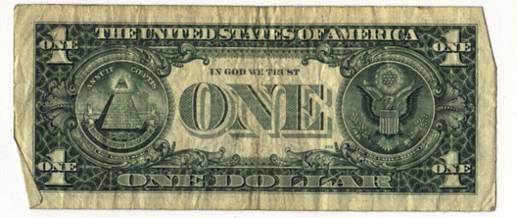
Take a $1 bill out of your pocket and look at the back of the Eagle:  the stars above the Eagle's head are in the six point Star of
David, to honor Jews.  If you turn the Eagle up-side-down you will see a configuration in the likeness of a Menorah, both at the
insistence of George Washington, who said we should never forget the Jewish People and what they have done in the interest of
America.

George Washington's financial advisor and assistant was a Jewish man by the name of Hayim Salomon.  During the cold winter
months at Valley Forge when American soldiers were freezing and running out of food and ammunition, it was Hayim Salomon
who marshaled all the Jews in America and Europe to provide money in relief aid to these stranded American troops and thereby
changed the course of history.  Without this help, Washington's Continental Army and the fate of the American Colonies would
have perished before they could have defeated the British.

Hayim Salomon (1740-1785) immigrated from Poland to New York at the age of 32.  He set up business as a bill-broker, purchas-ing and selling currencies at a discount.  When the Revolutionary War broke out, Salomon moved to Philadelphia and began to
negotiate the sale of Continental currency for hard French and Dutch bills.   Asking for a nearly negligible commission on trans-actions, he made himself available for Congress, which appointed him official Broker to the Office of Finance of the United States.  Salomon was able to maintain a thriving private business in addition to his official duties, despite his interest-free personal loans to such government officials as James Madison, Thomas Jefferson, General von Steuben, and General St. Clair.  Nevertheless, by the time Salomon died at the age of 45, private individuals and the government reputedly owed him $638,000.  He died penny-less, having used all his sources to aid the newly formed and poorly supplied American Continental Army.

Although Salomon never presented a claim for repayment, his son, Hayim B. Salomon, petitioned for such repayment after his
father's death.  Other descendants continued to petition Congress, although they gave up on repayment and simply requested
that a commemoration medal be issued in honor of Salomon, The "Financier of the Revolution".

In 1893, a bill was presented before the 52nd Congress ordering a gold medal struck off in recognition of Salomon's contribution to
the United States.

What would be the value of $638,000 today?  We would greatly appreciate it if some financial wizard could provide us with an
estimate of what $638,000 would actually be worth in today's terms.

Please do not misunderstand me I don't suggest that the Jewish People send the descendants of the Founding Fathers a bill for
services rendered!

To repay the debt owed Hayim Salomon and his fellow Jews for the help offered to the fledgling American state at the time of
the American Revolution, the U.S. should stop supporting the ungodly Saudi sponsored
"Road Map", and instead assist the
Jews to fulfill G-d's plan for them to return to the Promised Land and not to be uprooted again.

Two Biblical quotations come to mind at this time.  I think both of these quotations are very relevant to the current situation:

Amos 9:14, 15:
"I will return the captivity of My people Israel and they will rebuild desolate cities and settle them;  they will
plant  vineyards and drink their wine;  they will cultivate gardens and eat their fruits.  I will plant them upon their land and
they will never again be uprooted from their land that I have given them, said HASHEM, your G-d."


Genesis 12:3:
"I will bless those who bless you, and him who curses you I will curse; and all the families of the earth shall
bless themselves by you."


With love of the Bible and the Promised Land,

Ruth Matar

Jewish Symbols in the American one dollar bill?


Jewish Symbols in the American one dollar bill?
I received an email from a friend that described Jewish symbols in the American one dollar bill:

Click on image to enlarge

A while ago, at the West Point Academy's Jewish Chapel, there was a display about Hyam Salomon and the Revolutionary War. He died penniless, having used all his resources to aid the newly formed and poorly supplied American Continental Army. This is a wonderful story sent to me by a lawyer friend that shares my interest in history. I hope you will find it of interest to you:
General Washington's financial advisor and assistant was a Jewish man by the name of Hyam Salomon. During the cold winter months at Valley Forge when American soldiers were freezing and running out of food, it was Hyam who marshaled all the Jews in America and Europe to provide money in relief aid to these stranded American troops and turned the course of history. Without this help, Washington's Continental Army, and the fate of the American Colonies would have perished before they could have defeated the British.
If you take a one dollar bill out of your pocket and look at the back at the Eagle, the stars above the Eagle's head are in the six point Star of David to honor Jews. If you turn the Eagle upside down you will see a configuration in the likeness of a Menorah....both at the insistence of George Washington who said we should never forget the Jewish people and what they have done in the interest of America.

Well, I decided to do a bit of research (isn't the Internet great?) and found at least one article that questions the above. Although Hyam Salomon's story is true, the rest might be just wishful thinking. See below for the scoop

Money Man of the American Revolution was Haym Solomon

Money Man of the American Revolution was Haym Solomon

photo provided
Haym Solomon, a Jewish financier, was one of the unsung heroes of the American Revolution.
Fighting a war with weapons and tactics is one matter; financing a war is a different business. Not only does an army travel on its stomach, but it also marches on shoe leather. Kings and dictators confiscate what their armies require. Lincoln used inflation and high-interest Yankee bonds to bankroll Hooker, Burnsides, Meade, and Grant. When Robert E. Lee's Army of Northern Virginia invaded Maryland and Pennsylvania, they paid for what they requisitioned with worthless Confederate dollars.
No American commander had a worse time financially than George Washington, and no American congress has ever dithered and dallied as did the Continental Congress when the topic of war funding was broached. As Washington waged a war of attrition against the well-funded British military, he had to fret over how to make his payroll and how to pay his army's creditors.
In defense of Congress, Robert Morris was the official financer of the Revolutionary Army; however, it was New York immigrant Haym Solomon, a Polish Jew, who produced the money miracles when General Washington was in dire straits.
Robert Morris was a native of Liverpool who came out to the colonies as a 13-year-old lad accompanying his tobacco merchant father. In time Morris became as shrewd a trader as any in Philadelphia and he caught the eye of newspaper "magnate-turned-revolutionary" Benjamin Franklin. Morris, Franklin, and George Washington were bound by the ideals of liberty and severance from British rule. Furthermore, the three men were members of the fraternal and secretive order of Free Masonry.
When George Washington won an unexpected victory over British forces at Princeton in January 1777, Parliament sanctioned more soldiers for British Generals Clinton and Cornwallis, but it also authorized covert financial shenanigans against the fledgling rebels--subterfuges such as counterfeiting colonial paper money and discrediting American envoys in Holland and France. Their plan was to cause Washington's army to mutiny from lack of pay and necessities.
Since Philadelphia was a city rife with Tory sentiment, the Continental Congress despaired of conducting any secret negotiations. A select committee of men known only within their own circle made the financial arrangements for the struggling American army. So perilous was the status of the army that often their existence was a day-to-day affair.
George Washington was almost as adept as a spymaster as he was at fighting the war of attrition. The great commander had a system for planting incorrect information on the status of his army to confuse his British pursuers. The Culper Ring in New York was one of many such disinformation ruses. Nathan Hale was a part of this ring, as was the mysterious Agent 355, believed to be a young woman who moved easily within the circle of British Major John Andre and other notables.
Because Robert Morris was constantly under surveillance, Washington resorted to someone of lower profile whom he could trust. One of Washington's youngest staff officers was Lieutenant-Colonel Isaac Franks, a son of the senior partner of the import-export firm of Levy-Franks in Philadelphia. Isaac Franks was barely out of his teens, yet he was forage master for Washington's army that lay encamped about Long Island.
When Robert Morris found it nearly impossible to coerce financial contributions from the states for the war effort, Isaac Franks suggested that Washington contact his -- Franks' -- brother-in-law, the currency broker, Haym Solomon. In the hard war years that followed George Washington ordered his private couriers more than once to "Send for Haym Solomon."
Haym Solomon was a 36-year-old Polish Jew who'd immigrated to the colonies just one year prior to the outbreak of hostilities in 1776. Before the year was out, Haym Solomon had established himself in the import-export trade along New York's waterfront and he'd become a part of the John Lamb Sons of Liberty circle in that city. Lamb was one of the most zealous anti-British men on the continent -- years earlier his father had been deported to the colonies from London as a common thief. However, John Lamb was the catalyst for revolution among the business elites of the colony's leading port. Lamb kept up an active correspondence with hard-core revolutionaries such as Samuel Adams, Aedanus Burke, Patrick Henry, Richard Henry "Highthorse Harry" Lee, and Charleston's Christopher Gadsden.
Solomon proved his worth as a spy for Washington as well as a finance man. On several occasions Solomon was captured by the British and he used his commanding knowledge of European languages to talk his way, or bribe his way out of prison. Reputedly, he persuaded over 500 Hessian soldiers to desert the British cause for the American side. There are so many legends circulating about Haym Solomon that it is difficult to discern the facts. He did have contact with the Dutch Jewish community on St. Eustatius in the Caribbean, and that settlement of traders was one of the main suppliers of French-made rifles and other war materiel to the patriots. When the British got too hot on Solomon's trail of colonial intrigue, he moved his operations to Philadelphia. Solomon was known to run a private bank and investment brokerage from the back room of Philadelphia's London Coffee House. Here he sold commercial paper, shares in trading ventures, and he made personal loans to the Declaration Signers from his accumulated fortune.
In 1781, George Washington received word that a large army under the command of the Count de Rochambeau would be able to coordinate one brief campaign with the patriot forces. That was when Washington determined to strike a desperate blow against Lord Cornwallis who was encamped close to the Chesapeake awaiting the British fleets of Admirals Graves and Rodney to evacuate his forces to New York.
Robert Morris and Haym Solomon went into overdrive to produce the finances to supply Washington and his allies in the costly venture of moving south toward Yorktown. Philadelphia had probably never seen such wheeling and dealing, and some fantastic schemes were devised to deceive the ever-present Tory spies that hung about the London Coffee House.
What's interesting to us in the Lowcountry is that Daniel deSaussure of Charleston was in 1781 a member of the financial cartel in Philadelphia that included Robert Morris and Haym Solomon. DeSaussure, a wealthy Carolina merchant, had studied in Switzerland, and so had Solomon. Some years later Daniel deSaussure became the president of the Charleston branch of the (1st) Bank of the United States located on the corner of Broad and Meeting Streets, now City Hall.
At one juncture in the 1781 Yorktown financing, Haym Solomon ran afoul of even the lax colonial codes of financial propriety and was implicated in a $50,000 securities fraud. It was a critical moment in the funding of the patriot forces, and, for a while, it looked as though Solomon would be imprisoned by his own people as a huckster. Robert Morris sprang to the rescue and somehow got the tables turned on Haym's accuser and had that man arrested instead. At that point, Solomon threw his own fortune into the army's fund plus he sold another $20,000 in securities -- enough to purchase the critical supplies for Washington's army to move 200 miles south.
Of course, Washington and Rochambeau trapped Cornwallis at Yorktown. One of the ironies for the British was the fact that British Admiral George B. Rodney was too late arriving on the scene. He took a detour to destroy the Jewish settlement at St. Eustatius that had been supplying the colonists with weapons. Rodney burned their settlement, destroyed their small synagogue, and separated families and dispersed the St. Eustatius Jews all over the Caribbean as retribution for their aiding the American rebels.
Regrettably, Haym Solomon died shortly after the Revolutionary War, probably of tuberculosis contracted while a prisoner of the British in New York. He died penniless, having donated everything that he owned to the patriot cause. Attempts to receive restitution from congress fell on deaf ears, partly because it was all that Congress could do to pay a token pension to the soldiers.
During the war there were antisemitic cries raised against Haym Solomon and some of the other Jewish patriots who assisted in the financing of the cause. Solomon's 1781 Philadelphia newspaper editorial "I am a Jew" became one of the most eloquent pleas for religious understanding ever printed. The words, "I am a Jew; it is my own nation; I do not despair that we shall obtain every other privilege that we aspire to enjoy along with our fellow-citizens," have been cited in numerous patriotic essays.
Some admirers claim that Haym Solomon helped pen a draft of the Constitution before he died. Others claim that he and Morris devised the dollar sign, a clever reduction of the two marble columns entwined in ivy that are found on the 18th century Spanish-milled silver dollar known as the real, or pieces of eight. Some conspiratorial theorists believe that Haym Solomon was part of the shadowy Illuminati group that sought the overthrow of kings and the subsequent establishment of a one-world-government.
No conspiracies have been pinned on the patriot Haym Solomon. Solomon is a true Son of Liberty, and in 1975 the U.S. Postal service issued a stamp in his honor.
(Dr. Thomas B. Horton is a history teacher at Porter-Gaud School. He lives in the Old Village of Mount Pleasant).

Haym Salomon, Philadelphia broker


Haym Salomon

Philadelphia broker Haym Salomon (1740-1785) played a vital role in ensuring that the American colonies' fight to win independence from the British crown continued. During the 1770s, he brokered a number of large financial transactions that kept American soldiers clothed, fed, and armed. It is thought that this Jewish emigrant contributed much of his own assets to the war for independence because he died deeply in debt.
Haym Salomon was born in 1740 to a family of Portuguese Jews. His parents had been driven out of the Iberian peninsula by anti-Semitic laws enacted by the Spanish monarchy, and settled in Lissa (now Leszno), a part of Poland that, at the time, belonged to the kingdom of Prussia. The Jewish villages in the area, however, were sometimes decimated by vicious pogroms: a crime or incident would occur, Jews in the area came under suspicion for it, and then mob violence resulted in widespread incidents of assault, murder, and property destruction. One such conflagration threatened Lissa when Salomon was a young man, and caused him to flee to Holland.
It was probably during the 1760s that Salomon traveled in Europe. By the time he reached the British colonies he had acquired fluency in several languages. It is also thought that he possessed some university education. Salomon returned to Poland around 1770, but likely became involved in Poland's nationalist movement and was forced to flee the country again in 1772. This was the same year that the first of several partitions of Poland occurred, in which its neighbors allied to seize and divide amongst themselves Polish lands and effectively erase the country from the map. Salomon went first to England, and from there sailed to New York, under British control since the 1660s. It was a thriving port, and the center of commercial and shipping interests in North America. Salomon evidently possessed some knowledge of finance and accounting practices. He was able to find a job as a broker and commission agent for ships plying the Atlantic.

Acts of Sedition

During this time Salomon continued his political activism. He was active in a secret group, the Sons of Liberty, which had been established by men with business interests who were opposed to British rule. The Crown's colonial system ensured that a large part of the profits generated in the New World went to the British Exchequer, not the merchants and other colonial businessmen. Under unknown circumstances, Salomon was arrested by the British and charged with spying in September 1776. His multilingual skills caused his captors to station him with a German general named Heister. At the time, the German state of Hesse allowed its soldiers to serve as mercenaries as a revenue-creating measure. These troops, known as Hessians, were in North America to support British rule. As an interpreter for Heister, Salomon was allowed a relatively high degree of freedom. He contributed to the American revolutionary cause by persuading Hessians to switch sides.
After Salomon was released from custody, he married Rachel Franks, the daughter of a prominent merchant, in January 1777. He continued to work underground to sway Hessian allegiance, and was jailed a second time in August 1778 as one of several suspects thought to be planning a fire that would destroy the British royal fleet in New York harbor. The strategy also included a series of arson fires in British warehouses. He was sent to the Provost, an infamous prison, and a death sentence loomed. However, Salomon had hidden several gold guineas on himself, which were used to bribe a jailer and escape to freedom.

Success in Philadelphia

Salomon left British-occupied New York and crossed into New Jersey and then Pennsylvania. At the time, the city of Philadelphia was the center of the independence movement and home to the Continental Congress, the legislative body of the thirteen colonies that had declared their autonomy from Britain in 1776. Salomon spoke before the Second Continental Congress, offering his services and requesting a position, but was turned down. With some borrowed funds, he opened an office as dealer of bills of exchange. His firm on Front Street, near to the Coffee House where Colonial Army officers and members of the Continental Congress often gathered, began to flourish.
The revolutionary cause, in contrast, was in dire financial straits. The colonies were battling against an extremely wealthy enemy, the British Empire. Keeping the American forces supplied with arms, food, and other supplies, was a daunting task. Salomon came to know many leading figures in Philadelphia during this time, and brokered a loan of $400,000 that gave George Washington, head of the Continental Army, funds to pay his soldiers in 1779. It is thought that Salomon may have contributed his own funds to this aid package.

A Key Figure

Salomon became an associate of prominent Philadelphian Robert Morris, a member of Congress with close ties to Benjamin Franklin. Morris brokered many financial transactions that helped the revolutionary cause gather steam early on. By the winter of 1780-81 the colonial government was broke and Morris was appointed superintendent of finance. Salomon entered into more than seventy-five financial transactions with Morris between 1781 and 1784. He was almost the only broker for the sale of bills of exchange—bonds sold to provide funds for the war effort and salaries of top government officeholders. Salomon may have backed many of these with his own assets. Moreover, he was the principal broker for subsidies from France and Holland to help the American independence effort, and turned over his commissions on these transactions to the cause as well. He was also named an agent for merchandise that was seized by privateers loyal to the colonists, which he sold to help finance the war.
Records show that Salomon advanced in specie over $211,000 to Morris when the latter was superintendent of finance, and entered into other transactions with the government to the tune of over $353,000. There were also several promissory notes totaling $92,000. In all, the sum that Salomon advanced to help the war cause was over $658,000, an amount which was later recognized by Congress as valid. Some of these transactions were in specie or on revolutionary paper, and as such declined considerably in value after the war. The loans that Salomon advanced to men such as future presidents James Madison and James Monroe were assumed to have been settled between the parties.
Salomon maintained his Philadelphia brokerage throughout these years, and was also a devout practitioner of his faith. He was active in the city's Congregation Mikveh Israel, and once appeared before the Board of Censors to speak in opposition to a religious oath required of civil servants designed to keep those of the Jewish faith from such jobs. His firm began to experience financial losses after a 1783 recession, and he planned to relocate to New York City in 1785. According to one story, he petitioned the government for repayment, and was sent a sheaf of documents on a Saturday, the Jewish holy day. Salomon would not sign them because of the Sabbath laws against transacting business. On Monday he fell gravely ill. Other sources note that he had not yet tabulated the debts and presented his claim officially. What is certain is that Salomon died on January 6, 1785 in Philadelphia, a death attributed to tuberculosis.

Services Rendered, then Forgotten

When Salomon died at the age of 45, he was a bankrupt man with a wife, three children under the age of seven, and a fourth on the way. His estate was valued at $44,000, but had liabilities of $45,000. Not long after his death, his chief clerk, who could have been crucial to straightening out financial matters regarding the family debt, committed suicide. Attempts were made by his heirs over the next few years to obtain some retribution, but a series of suspect occurrences thwarted these challenges. It was alleged by the government, for instance, that papers concerning the Salomon estate claims were destroyed when government buildings in the District of Columbia were burned by the British in the War of 1812.
Salomon's fourth child, Haym Jr., met with President John Tyler in the early 1840s and reportedly left a sheaf of documents with him for his perusal. The box of papers later disappeared. The younger Salomon then petitioned the Senate Committee on Revolutionary Claims until 1864, when he was in his late seventies. He even offered to settle the claim at a sum of just $100,000. This was quite generous considering that, with interest, the actual amount owed would have spiraled to a debt of grand proportions. At this the Committee once more approved the claim's legitimacy and submitted it to Congress, which again failed to approve the expenditure.

A Shameful Legacy

At some point after the 1860s, a cache of Salomon papers remaining in Congressional archives was discovered to be missing. Many of them concerned financial dealings and bore the signatures of Washington, Jefferson, and other historic figures. They were likely pilfered for the value of these autographs. In 1893, Salomon's heirs petitioned Congress to strike a commemorative medal in honor of their patriotic forebear, with a Congressional appropriation submitted in the amount of $250, but this was also rejected. Future president Woodrow Wilson sat on a committee charged with the task of founding a university in Salomon's honor in 1911, but the project was derailed by World War I.
Salomon, who is buried in the cemetery of Mikveh Israel, was finally commemorated with a Chicago statue by famed sculptor Lorado Taft, and finished by Leonard Crunelle. The heroic memorial depicts Salomon, Morris, and Washington, and was dedicated in 1941 at the corner of Wacker Drive and Wabash Avenue. Known as the Heald Square Monument, it bears the inscription: "Symbol of American tolerance and unity and of the cooperation of people of all races and creeds in the upbuilding of the United States."

Further Reading

Fast, Howard, Haym Salomon: Son of Liberty, Julian Messner, Inc., 1941.
Hart, Charles Spencer, General Washington's Son of Israel and Other Forgotten Heroes of History, Lippincott, 1937.
Russell, Charles Edward, Haym Salomon and the Revolution, Cosmopolitan Book Corp., 1930.
Schwartz, Laurens B., Jews and the American Revolution: Haym Salomon and Others, McFarland and Co., 1987. □

Who Was Haym Solomon? Dollar bill


Who Was Haym Solomon?

The back of a U.S. $1 bill bears thirteen stars arranged in a Star of David pattern as a reward extended to Haym Solomon by George Washington.


On the rear of the One Dollar bill, you will see two circles. Together, they comprise the Great Seal of the United States .


The First Continental Congress requested that Benjamin Franklin and a group of men come up with a Seal. It took them four years to accomplish this task and another two years to get it approved.


If you look at the left-hand circle, you will see a Pyramid.


Notice the face is lighted, and the western side is dark. This country was just beginning. We had not begun to explore the west or decided what we could do for Western Civilization. The Pyramid is uncapped, again signifying that we were not even close to being finished. Inside the capstone you have the all-seeing eye, an ancient symbol for divinity. It

was Franklin's belief that one man couldn't do it alone, but a group of men, with the help of God, could do anything.


'IN GOD WE TRUST' is on this currency.


The Latin above the pyramid, ANNUIT COEPTIS, means, 'God has favored our undertaking.' The Latin below the pyramid, NOVUS ORDO SECLORUM, means, 'a new order has begun.' At the base of the pyramid is the Roman Numeral for 1776. (MDCCLXXVI)


If you look at the right-hand circle, and check it carefully, you will learn that it is on every National Cemetery in the United States It is also on the Parade of Flags Walkway at the Bushnell, Florida National Cemetery , and is the centerpiece of most hero's monuments. Slightly modified, it is the seal of the President of the United States, and it is always visible whenever he speaks, yet very few people know what the symbols mean.


The Bald Eagle was selected as a symbol for victory for two reasons: First, he is not afraid of a storm; he is strong, and he is smart enough to soar above it. Secondly, he wears no material crown. We had just broken from the King of England Also, notice the shield is unsupported. This country can now stand on its own. At the top of that shield you have a white bar signifying congress, a unifying factor. We were coming together as one nation. In the Eagle's beak you will read, ' E PLURIBUS UNUM' meaning,'one from many.'


Above the Eagle, you have the thirteen stars, representing the thirteen original colonies, and any clouds of misunderstanding rolling away. Again, we were coming together as one.


Notice what the Eagle holds in his talons. He holds an olive branch and arrows. This country wants peace, but we will never be afraid to fight to preserve peace. The Eagle always wants to face the olive branch, but in time of war, his gaze turns toward the arrows.


They say that the number 13 is an unlucky number. This is almost a worldwide belief. You will usually never see a room numbered 13, or any hotels or motels with a 13th floor. But think about this:


13 original colonies,
13 signers of the Declaration of Independence,
13 stripes on our flag,
13 steps on the Pyramid,
13 letters in, 'Annuit Coeptis,'
13 letters in 'E Pluribus Unum,'
13 stars above the Eagle,
13 bars on that shield,
13 leaves on the olive branch,
13 fruits, and if you look closely,
13 arrows.


And finally, if you notice the arrangement of the 13 stars in the right-hand circle you will see that they are arranged as a Star of David. This was ordered by George Washington who, when he asked Hayim Solomon, a wealthy Philadelphia Jew, what he would like as a personal reward for his services to the Continental Army, Solomon said he wanted nothing for himself but that he would like something for his people. The Star of David was the result. Few people know that it was Solomon who saved the Army through his financial contributions but died a pauper.


I always ask people, 'Why don't you know this?' Your children don't know this, and their history teachers don't know this. Too many veterans have given up too much to ever let the meaning fade. Many veterans remember coming home to an America that didn't care. Too many veterans never came home at all.


I for one, plan to share this page with everyone, so they can learn what is on the back of the UNITED STATES ONE DOLLAR BILL, and what it stands for!